George Monbiot, in a moment of quietly feral contemplation.

I’ve finally got the chance to write a review essay, “Forget Fertility, Get Feral”, about the work of George Monbiot—one of my favorite writers. His career advice is the best anti-establishment pep talk on the internet and his work on ecology and social justice played a big part in focusing me on climate politics. I’m not sure he would agree with my review, with is in part a jeremiad against the overly pious “family values” language of environmentalists’ endless invocation of our children and grand-children. Oh well. But hopefully he’ll agree with me that Fera‘s prose is something special:

We might still wonder whether we’re ready to unleash the forces we’ve spent centuries working to master. Doesn’t nature belong outside of us, a realm of necessity to transcend? Monbiot’s prose exemplifies a more interesting perspective, expressing at once a childlike and erotic intimacy with the wild. “The oaks had put out embryo leaves as minutely serrated as mouse paws,” he writes. “The fronds of the horse chestnuts in town, which had hung like empty gloves, began to stiffen and splay. Bracken unrolled leaflet by leaflet like a Mandelbrot set.” I don’t even know what a Mandelbrot set is, but I’m enchanted, and I think I’d like to have one.
“[A] knot in brick-red breeding plumage ran along the sand dipping its head, then took off with a long swooping whistle,” he writes. “A bumble bee trapped in the surface film broadcast frantic barcode ripples: sound made visible.” Or: “[The spider crab] looked like the grab used to lift crushed cars in a scrap-metal yard. Its claws were more than two feet from tip to tip, powerfully ridged and bossed, crenallated on the cutting edges … It bulged with the suggestion of muscle like a Roman suit of armor.”
Over and over, Monbiot deploys the precise vocabularies and unexpected analogies that George Orwell implored us to substitute for bad abstraction in political writing.4 When politics get cruel, Orwell argued, lazy abstraction veils the authentic, troubling truth. Orwell did not pose precision and concreteness in opposition to the abstract per se. These were, rather, autonomous encounters with general principles, meticulous detail and fresh images exposing an active mind at work. “The great enemy of clear language is insincerity,” Orwell wrote. Monbiot is as clear and sincere as Orwell could wish for—and he is hopeful, too.
Monbiot’s analogies not only perform intellectual vigor in general; their substantive threads entwine human and nonhuman activity, weaving the human spirit with creature, land, and sea. Human freedom depends on the freedom of the wild, but the magic of the wild depends on human art. Monbiot’s anthropomorphism of ecology is abstract and encompassing, an enlightened, secular pantheism for the 21st century. Getting feral, as I see it, means injecting environmentalism with the adrenaline of an insurgent, democratic modernism.

Ok. Now go read read the whole essay.

Later I’ll explain how this forms the final part of my first triptych on climate change and pleasure.

Trevor Kluckman as Tom in Buzz (courtesy of Christopher Ash)

Trevor Kluckman as Tom in Buzz (courtesy of Christopher Ash)

I ask what it really means to live in the face of climate catastrophe in my review of Benjamin Kunkel’s new play about climate change, BUZZ. A couple excerpts:

It’s true, an allegorical play for a tiny audience in a cramped loft, about characters struggling with omnipresent little bugs, seems a curious approach to the temporal and spatial enormities of climate change. But this is precisely Kunkel’s point. The paradox of climate change is that the very thing that should planetize us, making us all global cosmopolitans under the hot sun of philosophical reckoning, instead drives us back into the cave—ideally, to a dark and isolated nook—even as ghosts of the blinding light dance on our retinas. Climate change is so big that we shudder and shrink.

Fertility against extinction; childhood against cynicism. These are old themes. You’ll find the pregnancy-vitality circuit everywhere in discussions of climate change, from op-eds to Naomi Klein’s This Changes Everything to the more opaquely allegorical Children of Men. There’s an unfortunate gender dynamic at play here. And we’ve all encountered enough stories and arguments that enlist the vulnerable child trope for too-easy emotional effect. In Canada, the last volley of anti-gay marriage ads demanded, “What about the children?” Yes, yes, yes, our grandchildren will suffer more from global warming than we will—not to mention the children overseas, in more vulnerable locales. The more difficult and interesting problem is: how should we, living, self-conscious beings, balance freedom, pleasure, and responsibility in our own selves, right now?

cohen_hamptons

Loading the Bicycles / Gare Saint-Lazare (July 1936)

My essay Seize the Hamptons: We should all get the chance to escape the city and enjoy leisure — without the hefty ecological footprint came out today in a beautifully designed, city-themed double issue of Jacobin. And the editors have graciously made it available for even non-subscribers—but support smart long-form journalism and subscribe!

The basic premise is that, despite the hype, density as such isn’t enough to reduce our urban carbon emissions. Actually, as we’ve known all along, we have to cut back on consuming things too. (In San Francisco and Seattle, over two thirds of emissions caused by in-city consumption actually occur beyond city limits.) Snooze. The fun part—which I won’t spoil here—is that actually, the solution could be the shameless pursuit of low-carbon leisure, inside and outside cities. Sounds far-fetched—but actually, as you can see from the lovely French workers shown above, there are already historical precedents for what we need to do in the annals of 20th century struggles from below. Indeed—there are far more examples (including contemporary North American cases) than there was space to explore in the article.

So—for the fun details, delivered in all their narrative glory, read the piece. Get yourself a physical copy. And come back in a week for a post where I’ll describe the piece’s key intellectual sources, including cutting-edge dissertation research from some of my colleagues at NYU.

Screenshot 2014-10-06 15.27.08Last Friday evening I had the privilege of going on New York 1 to talk about the Tale of Two Sandys report that the Superstorm Research Lab, of which I’m a founding member, released nearly a year ago. You can watch the whole in-depth interview here.

Hurricane Sandy’s two-year anniversary is coming up this month, and NY1 is ramping up its coverage. In the interview, I talked about our finding, based on nearly 80 interviews, that the storm was really experienced in two different ways by different groups of New Yorkers—as a short-term interruption of the status quo from above; and as an exacerbation of long-running social and economic insecurities from below.

For instance, I cited research showing that in storm-affected areas, 45% of units in NYCHA (public housing) buildings had visible mold soon after Sandy struck. But  34% of units had visible mold before Sandy struck.  This is the basic Two Sandys hypothesis—for the full version, check out our report.

I also said that Mayor De Blasio’s administration had in a lot of ways adopted the second Sandy perspective, focusing on long-term economic and social insecurities as he works with community based organizations which helped get him elected, and which continue to pressure him. These groups are happy with a lot of the changes made to the recovery process under De Blasio. But as I said on the show, one area where they are warning that more work is needed, is in providing adequate aid to renters. If there is another Sandy this fall, we still won’t be able to track displaced renters with any accuracy—never mind providing them with the relief that they need.

Note that SRL member Alexis Merdjanoff actually spotlighted the issue of tenants’ particular vulnerability on a blog post many months ago.

Indeed, although it was my pale, anxious face on screen, the the Tale of Two Sandys report was written collectively by Erin Bergren, Jess Coffey, Ned Crowley, Liz Koslov, Max Liboirox, Alexis Merdjanoff, Adam Murphree, David Wachsmuth, and me. Plus research from Michael Gould-Wartofsky, Lisa Ng, and Shelly Ronen. And Melissa McCrumb of Make the Road New York New York and Susannah Dyen of ALIGN NY brought me up to speed on some key recent developments. Just like Hillary Clinton says, It takes a village!

Yesterday, Graham Beck at Next City did a great write-up of the Superstorm Research Lab. I appreciated his very flattering description of us:

a young cadre of social scientists […] is quietly rethinking business as usual in academia. Though their work fits squarely in the established field of disaster sociology, the Research Lab is deeply invested in pushing the boundaries between scholarly research and efforts to make real change.

He interviewed me in writing the story. I thought I had rambled incoherently, but he did a nice job picking out some comprehensible bits—especially in relating the way that our mutual aid, public engagement approach made it possible to see the storm’s aftermath in an especially expansive way (or with a lot of depth of field):

Perhaps even more significantly, they pooled all of their individual research and made it public. “It’s a novel method that allowed us to use a data set that none of us individually could have come up with,” [Cohen] said. “In the age of Occupy Wall Street, some of those ideals of transparency and openness can and should thrive in research.”

Depth of field contrastIn January, I went to the Queens FEMA office with one of my SRL colleagues to present on our research during a big meeting in their “situation room”. It was a pretty big room, with a lot of screens. I thought I’d post a visual excerpt from the presentation here, as I’ve been thinking through different metaphors one might use to describe multi-actor research and still not sure this is the right one.

Here’s the basic idea. On the one hand, it’s obvious that in research one would speak to many “actors”. But in practice, a lot of academic and policy-oriented urban studies, especially qualitative ones, end up being studies of a particular (sometimes “representative”) group, like people in a poor neighbourhood, or elites, etc etc. This allows the researcher to focus closely, which in this presentation I said was analogous to photographers using a shallow depth of field. It puts one actor in focus, while blurring out the background. Meanwhile, some sociological studies, and many of the most famous novels about cities, like Dickens’ Tale of Two Cities, are totally different. Their whole effect comes from contrasting the clashing experiences and subjectivities of people from different groups (in A Tale of Two Cities, it’s high and low society in both London and Paris).

In the presentation, I argued that unlike most qualitative studies of Superstorm Sandy’s aftermath, our Research Lab had taken this multi-actor approach to try to get an encompassing picture of the city’s overall response, including clashing experiences and subjectivities. Authors of fiction can do this easily, since they make up their stories. For individual qualitative social scientists, it’s hard to find the time to track multiple groups. But in a mutual aid group like Superstorm Research Lab, we could divide and share our labor to cover more ground. So we interviewed people form government, established civil society, volunteer responder networks (mainly Occupy Sandy), and people directly affected by the storm (especially in Coney Island). It was this approach that yielded our discovery that there had been not one, but Two Sandys, each of which was a really distinct understanding of the storm, with important implications (as our report elaborates). We could think of this approach as extending our depth of field, which reduces the contrast in focus between foreground and background (ultimately, putting everything in equal focus).

In cinema, this approach’s full potential was pioneered by Orson Welles’s Citizen Cane. I think there’s a connection between the cinematography and the film’s clarification of extreme social contrasts, but that discussion is for another day. To make my point in the presentation, I showed the two images, pasted above, from the Humphrey Bogart film The Big Sleep—using photoshop to simulate a shallow depth of field in the first image. What I loved about the way these turn out completely differently, once you restore the proper depth of field, is that you don’t just see more actors when everyone is in focus. You see, a) more sets of relations between actors; and b) some of those relations are invisible to the actors themselves. In works of fiction, especially tragedy, we often call instances of this second situation dramatic irony. In qualitative social science, it’s just tragic that researchers rarely make the efforts to study, all at once, multiple actors (and their points of view).

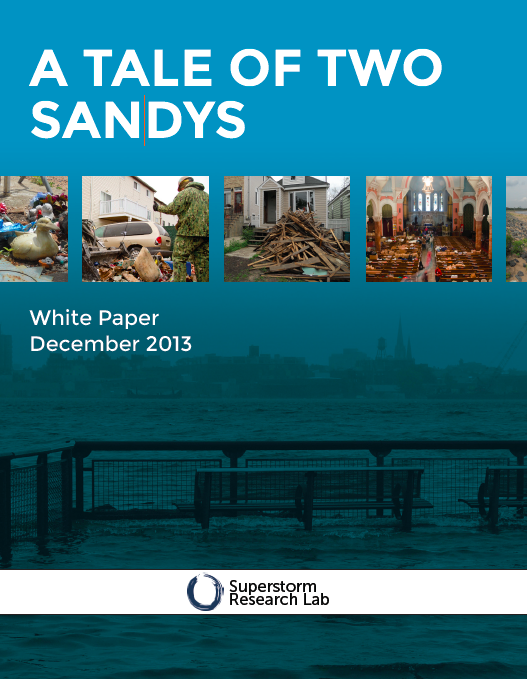
srl-white-paper-cover-image

Better late than never! The research group on Sandy’s aftermath that I work with, Superstorm Research Lab, released this report months ago. This was produced by a non-hierarchical, mutual aid group of scholars, primarily PhD students, and one then-post-doc. I’m pretty proud of what we accomplished, and our group is still buzzing with ongoing and new projects. A couple of us are now working on a shorter piece that summarizes, develops, and extends the report’s findings. And I’m completing an academic article on the pretty un-noticed revolution in the city’s climate politics that occurred after the storm. More on these soon. Meanwhile, for the record, below is the text of our initial release. You can download the whole report here.

Responses to Hurricane Sandy consistently cluster into two types according to how the issues have been defined and understood. On one hand, the crisis was seen as an extreme weather event that created physical and economic damage, and temporarily moved New York City away from its status quo. On the other hand, Hurricane Sandy exacerbated crises which existed before the storm, including poverty, lack of affordable housing, precarious or low employment, and unequal access to resources generally. A Tale of Two Sandys describes these two understandings of disaster and discuss their implications for response, recovery, and justice in New York City.

The white paper is based on 74 interviews with policymakers, environmental groups, volunteer first responders, and residents affected by the storm; ethnographic observation; analysis of public reports from government, community-based organizations, and other groups; qualitative analysis of canvassing forms and data; and a review of the academic literature on disaster response. As a framing document, A Tale of Two Sandys selects certain case studies for their exemplary nature, including how different groups identified vulnerable populations,  timelines for aid and recovery, a case study of housing and rebuilding, and finally, urban climate change politics. The primary purpose of A Take of Two Sandys is to propose a sophisticated, accurate, and useful way of understanding the inequalities entwined with Sandy’s aftermath and to enable ways to address them.

I’m going to updating the blog more often now. But I wanted to recap a couple important bits that happened during my hiatus.

Screen Shot 2013-09-17 at 11.43.35 PMEDTMy extended book review of Brian Gareau’s From Precaution to Profit: Contemporary Challenges in the Montreal Protocol has just gone up at the Journal for World Systems Research.

It’s a great book for a couple reasons. First, because it explains what’s gone wrong with the Montreal Protocol, which so many people think of as the gold standard of global green treaties. And second, because it seeks to cash out the implications of the Protocol’s decline for global climate politics. As I argue in the review, he does especially well on the first count. And his efforts on the second are a great foundation for thinking through what is and isn’t possible for global treaty-making in a neoliberal era.

Here’s the review’s opening bit:

Since the disastrous 2009 Copenhagen climate talks, global climate governance has roiled in crisis. Michael Grubb, a long-time influential advocate for a binding global climate treaty, has warned that the world could enter its “darkest hour” (Grubb 2011). Other scholars now argue that small clusters of countries should negotiate treaties amongst themselves, and expand their clubs over time (Victor 2011). Some have even suggested a “G-2” solution decided by the United States and China alone. On the left, climate justice and “system change” activists are more likely to reject talk of any carbon-trading settlement altogether, despite the occasional radical defense of a global cap-and-trade scheme (Hahnel 2012). Still, a universal treaty remains on the global agenda. And the Montreal Protocol is the precedent most often cited as a uniquely effective example of global environmental governance, thanks to the steep reductions in ozone depleting substances it has achieved since entering into force in 1989.

Yet as Brian J. Gareau shows in From Precaution to Profit: Contemporary Challenges in the Montreal Protocol, this ostensible success story is misunderstood, with important implications for global climate politics.

Read the rest here (it’s the first review of the bunch).

A quick note: New York-based research community, the Superstorm Research Lab, has relaunched its website. It’s now gorgeous, stuffed with intriguing data, and getting bigger and better by the day. Check it out: www.superstormresearchlab.org.

A magazine piece I wrote on Brazil’s Climate Justice movement has just come out in NACLA: Report on the Americas. PDF here: “A most people’s climate movement?